

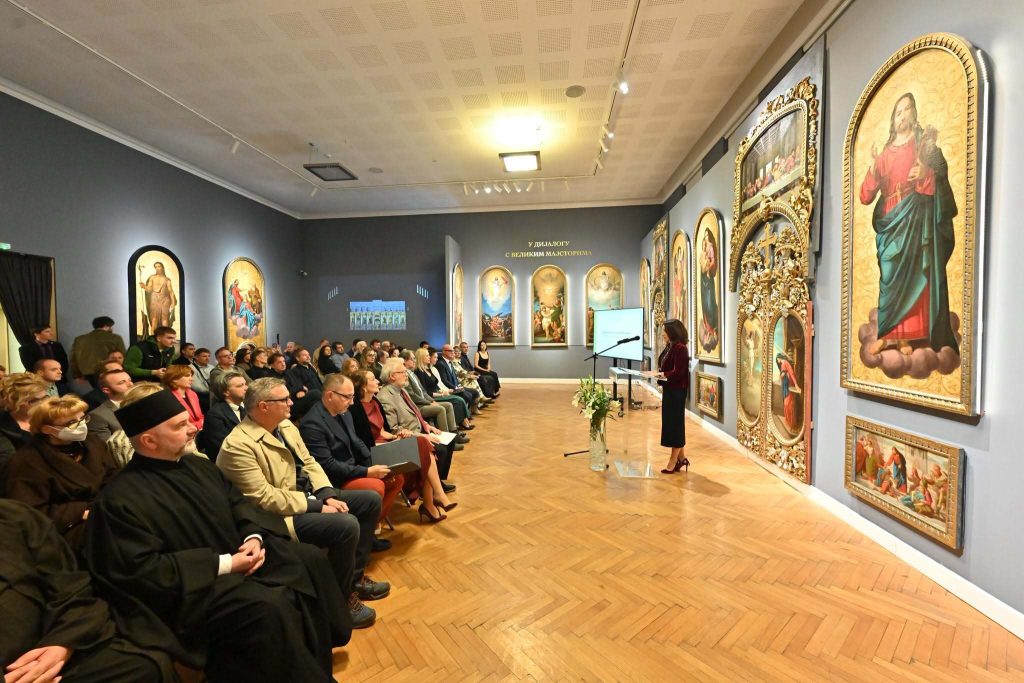
For institutions such as the Gallery of Matica Srpska, whose history and activities span more than a century, every year is unique in its own way. 2026 is a particularly significant year, in which we are celebrating a major anniversary, two centuries of the Matica Srpska, the oldest literary, cultural, and scholarly institution among the Serbs, which engendered both the Library of Matica Srpska and our own institution, once the Museum, and today the Gallery of Matica Srpska.
Our activities have been intertwined and closely connected from our very beginnings to the present day. The aspirations of Serbian intellectuals, and later of the state, to preserve Serbian culture through organized activities, were pursued simultaneously in the fields of literature, social sciences and humanities, visual arts, and publishing.
Artworks initially came to be collected even before the Matica Srpska was founded in Pest in 1826, alongside efforts to preserve the Serbian language and literature, embodied in the publication of the Chronicle of Matica Srpska, which began in 1824 and has continued to the present day. Originally, the idea was to gather portraits of distinguished Serbs and to create a Pantheon through which a visual representation of national identity could be shaped. It was precisely there, at the Tekelijanum, the home of the Matica Srpska, in a hall intended for the display of portraits of distinguished Serbs, that, twenty years after the founding of the Matica Srpska, the decision was made to establish the Serbian National Collection, or the Museum. When the Matica Srpska was relocated to Novi Sad in 1864, the art collection assembled up to that point was also transferred, together with all the other property and books. Inventory records show that it comprised one hundred items. Driven by the desire to awaken national consciousness, the collection of portraits was expanded to include works depicting historical themes. In 1881, the Serbian National Paper invited the Serbian public to contribute to the creation of the future museum through donations. The museum continued to grow, and in 1933 it opened its doors to the public for the first time, making its collection accessible to visitors. In this way, the Matica Srpska took on a new role in addition to its many existing ones – that of a museum – and, alongside the permanent exhibition, it also began organizing temporary exhibitions. The end of the Second World War and the political changes that ensued led to the Library and the Gallery becoming independent institutions. Yet even their relocation into separate buildings did not sever the ties between them. They have remained closely connected and have continued to work together. Through their activities, they have carried forward and developed the ideas of their founders: building their art and book collections, preserving and shaping national identity through art, and educating future generations through literary and artistic creation. Together, we have preserved Serbian cultural heritage and the works collected by our predecessors, marked important anniversaries, and left new material and artistic traces of those who have become part of the history of the Matica Srpska and Serbian culture. We have commissioned and purchased paintings, and created sculptures, plaques, and medals, just as generations of members of the Matica Srpska have done before us. Today, in this jubilee year, we stand together, side by side, aware of the importance of the mark we are meant to leave of our own time and of the values we have inherited and transformed into a tradition that we are proud to continue. For this reason, among the many programs organized by the Matica Srpska this year, the Gallery has added several of its own: an exhibition, a catalogue, and a film devoted to the Art Collection of Matica Srpska, as well as the complex exhibition and multidisciplinary project entitled “Splendor and Glory of the Metropolitanate of Karlovci. Art in the Service of Faith”, devoted to the Metropolitanate of Karlovci as a political and religious phenomenon within which the Matica Srpska was founded and developed. Lastly, tonight we open the exhibition devoted to the painter Aksentije Marodić and, after more than half a century, we present his remarkable body of work to the public. We bring before our audience the most comprehensive overview of his oeuvre as the Matica Srpska’s first privileged painter, entrusted with shaping its visual identity through portraits of its presidents and prominent figures. At the same time, we present him as a highly cultivated artist who boldly embraced European artistic influences and developed a distinctive style of his own. After three years of preparation, we are also exhibiting the restored iconostasis from the church of the Kovilj Monastery, thereby demonstrating that our responsibility extends beyond our own collection to the preservation of national cultural heritage.
In addition, we have organized several exhibitions at important centers of Serbian culture, in Szentendre, Leskovac, Trebinje, and Banja Luka, with the aim of highlighting, in other Serbian cities as well, the significance of the Matica Srpska’s anniversary and the broader contribution of its work to Serbian cultural life.
Last weekend, on October 10, we marked the bicentennial of the Matica Srpska in Budapest, at the Tekelijanum. The following week, on November 3 and 4, we will present two exhibitions in Banja Luka: “Matrix of the Matica’s Bicentennial” at the Gallery of the Academy of Sciences and Arts of the Republic of Srpska, and “Artists’ Studios” at the Museum of Contemporary Art of the Republic of Srpska.
As this year draws to a close, we begin preparations for several important anniversaries in 2027. Next year, we will be marking 180 years since the founding of the Gallery of Matica Srpska, as well as 180 years since the first portrait of Sava Tekelija, commissioned from Jovan Popović for the Pantheon of Matica Srpska. At the same time, we will be celebrating the centennial of the construction of the Gallery’s building and the centennial of the publication of the timeless book Serbian Art in Vojvodina by Veljko Petrović and Milan Kašanin. To mark these anniversaries, we will also be launching two new projects: “Novi Sad Citizens Choose”, through which we will highlight the civic spirit in which the Matica Srpska was founded and in which it continues to operate today, and “A Century of the Gallery of Matica Srpska Building”, which will allow us to present to the public the building that has been our home for the past seventy years, a place where we continue to create programs for the future and for the pride of the nation.
Tijana Palkovljević Bugarski, PhD
Director of the Gallery of Matica Srpska