

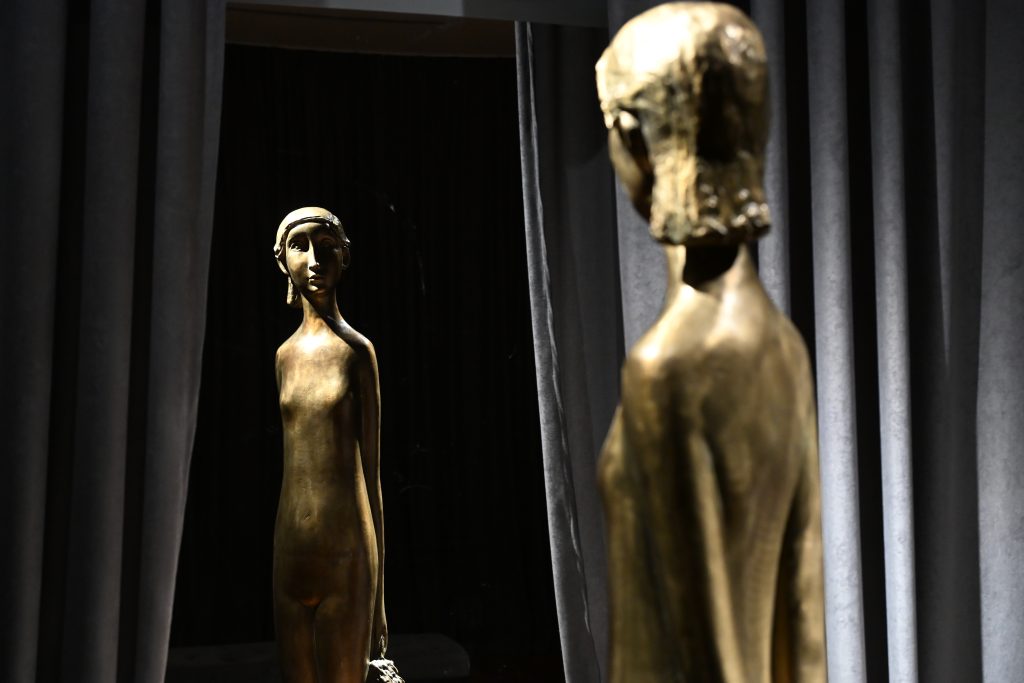
During 2025, two sculptures were cast in bronze: Rest by Đoka Jovanović and Bouquet II by Miroslava Sandić. On this occasion, in April – the month associated with change, new beginnings, and the awakening of nature, we present a monumental sculpture by our sculptor, whose work represents a significant contribution to the collection of sculptures at the Gallery of Matica Srpska. Miroslava Sandić belongs to the group of the most prominent sculptors of the second half of the 20th century. She was born in Belgrade in 1924, where she also studied sculpture (1951–1956), and later completed her master’s studies under the sculptor Ilija Kolarović. From a biographical perspective, she belongs to a generation of artists who built their education and artistic development on the foundations of academic realism, but who soon opened up to more contemporary and personal interpretations of form. Her work reveals a strong knowledge of anatomy, as well as confidence in modeling volume, which allows her to consciously reduce and stylize form without losing expressiveness.
The work of Miroslava Sandić represents a complex and subtle dialogue between figuration and stylization, between the discipline of classical sculptural craft and a pronounced need for a poetic, almost illustrative narrative in sculpture. Her art can be understood as a continuous exploration of the relationship between the body, ornament, and symbolism, where the figure is never just an anatomical object, but also a carrier of a poetic inner world and aesthetic values. In her work, she directed the language of sculpture toward themes that were her visual, aesthetic, and emotional preoccupations. Before us stands a nude young female figure, shaped with a balance between realistic and idealized representation. The body is calm, contained within its own vertical axis, while the gesture – the holding of a bouquet of flowers behind the back – introduces a layer of symbolism and subtle narrative. The hidden bouquet suggests intimacy, restraint, and at the same time the act of giving, which adds a story to the figure, while the bouquet brings that story into presence. This approach brings Sandić closer to an illustrative poetics, in which sculpture functions almost like a three-dimensional drawing – clear, readable, and suggestive. In her depictions of the human figure, calmness and a meditative quality (though not passivity) almost always dominate. Through these qualities, Sandić introduces subtle details such as a ball, a paper boat, a kite, a toy, and ultimately a bouquet, using them to illustrate the action within the work.
Goran Vujkov, museum educator